
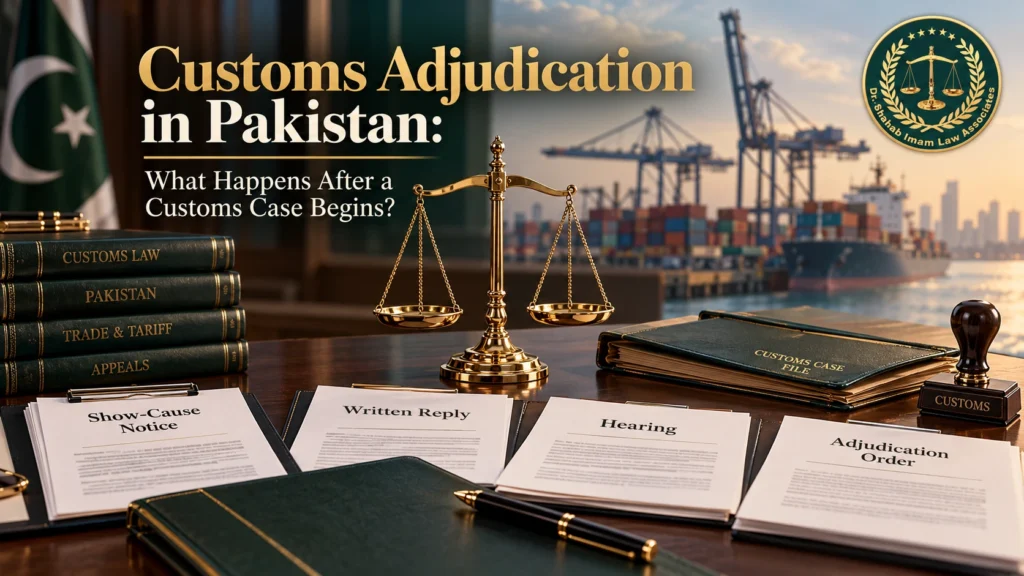
Customs adjudication in Pakistan is the formal process in which a Customs officer decides whether goods should be confiscated or a penalty imposed. The adjudication process usually starts with a show-cause notice. The importer or exporter can reply in writing and be heard before the officer issues a written order. That order can then be challenged on appeal.
TL;DR: Quick Facts
- Adjudication is a formal decision process. A Customs officer decides the case under the Customs Act, 1969.
- A show-cause notice usually opens the case. The notice sets out the allegation, the proposed action, and the reply deadline.
- You have a right to be heard. Customs cannot order confiscation or a penalty without first hearing your side.
- Your evidence shapes the record. The officer weighs your documents and arguments against the Customs record.
- The order can be appealed. The correct appeal forum depends on the officer and the type of order.
What Is Customs Adjudication in Pakistan?
Section 179 of the Customs Act, 1969 gives Customs officers the power to decide confiscation and penalty cases. Section 180 sets the steps they must follow first. Check the current rules in the Customs Act published by the Federal Board of Revenue, amended up to 30 June 2026.
Confiscation means the goods are taken by the government.
Not every customs dispute follows the same process. Three kinds of matters work differently:
- Customs inquiry. Customs may examine a shipment or ask for documents before deciding whether to take formal action.
- Formal adjudication. A Customs officer hears the case and decides it in a written order, often called an order-in-original.
- Criminal case. A court, such as the Special Judge (Customs), hears a criminal case under a separate process.
Why Does Pakistan Customs Start Adjudication Proceedings?
Customs starts adjudication when it believes goods or a declaration may break the Customs Act. Grounds can include:
- Alleged misdeclaration. Customs believes the Goods Declaration (GD), the form filed to declare goods, does not match the goods.
- Classification dispute. Customs believes the goods belong under a different Pakistan Customs Tariff (PCT) code, which can change the duty rate.
- Incorrect value or quantity. Customs believes the declared value or quantity is wrong.
- Duty-related violation. Customs believes less duty or tax was paid than the law requires.
- Other breaches. Customs believes a permit, restriction, or other legal condition was not met.
A dispute over a valuation ruling follows a separate review route, so challenging a customs valuation decision in Pakistan needs its own approach.
An allegation on its own does not prove you broke the law.
What Happens After You Receive a Customs Show-Cause Notice?
A show-cause notice is the written notice that opens adjudication. The notice usually states the allegations, the sections of law involved, and the proposed action. Section 180 requires three steps before any confiscation or penalty.
- Written grounds. The person concerned is told in writing why the action is proposed.
- A written reply. The person can reply within the time set in the notice.
- A hearing. The person is given a reasonable opportunity to be heard.
Note the reply deadline printed on your own notice first.
What Should You Check Before Preparing Your Reply?
- Notice details. Record the notice number, its date, and the date you received it.
- Shipment documents. Match the notice to the correct GD and goods.
- Allegations. List each allegation separately so that each gets its own answer.
- Relied-upon records. Note every document Customs says it relied on.
- Issuing authority. Identify the office and officer who issued the notice.
- Response instructions. Check how and where the notice asks you to reply.
How Should an Importer Respond to Customs Adjudication?
A strong reply answers each allegation with facts and documents. The right documents depend on the allegation. The following records belong to the wider set of documents needed for import and export legal matters.
- Invoices. The commercial invoice shows the price and description billed.
- Goods Declarations. The GD shows what was declared to Customs.
- Packing lists. The packing list shows the count and weight of the goods.
- Payment records. Bank records show how much was paid and when.
- Permits. A permit or certificate shows the goods met import conditions.
- Correspondence. Earlier letters show what each side said and when.
Answer each allegation under its own heading. Do not admit a fact your records do not support. Keep a dated copy of everything you file.
What Happens During a Customs Adjudication Hearing?
The personal hearing is your opportunity to present a defence, submit records, and answer each allegation. You may attend in person or, where allowed, be represented. Keep your own note of each hearing and what you submitted.
Can You Challenge the Evidence Used by Customs?
Yes. An importer may contest disputed facts, records, and legal interpretations through the procedure available in the case. Ask for copies of the records the notice relies on. Point out any error in writing.
What Decisions Can the Customs Adjudicating Authority Make?
The adjudicating authority is the deciding officer, such as an Additional Collector or a Collector of Customs (Adjudication). Not every outcome applies in every case.
- Allegations dropped. The officer may find the allegations are not proved.
- Confiscation. The officer may order the goods to be confiscated.
- Penalty. The officer may impose a penalty on the person found liable.
- Fine instead of confiscation. Under Section 181, the owner may be allowed to pay a fine instead of losing the goods, where the law permits.
- Other lawful consequences. The officer may order any other result the Customs Act allows.
The Lahore High Court has held that an officer cannot rewrite their own order, except to fix a clerical or arithmetic slip. Any other change must come through an appeal.
Can You Appeal a Customs Adjudication Order in Pakistan?
Yes. As the Sindh High Court has described the route, an appeal lies to the Collector of Customs (Appeals) under Section 193. A further appeal lies to the Customs Appellate Tribunal under Section 194A.
The correct forum and filing period depend on the officer and the type of order. Check both as soon as the order arrives, because time limits apply.
What Documents May Be Needed for an Appeal?
- The order. The adjudication order is the decision being challenged.
- The notice. The show-cause notice shows the original allegations.
- Your written reply. The reply shows the case you put forward.
- Supporting records. Your documents show the facts behind the reply.
- Hearing documents. Your notes and filings show what happened at the hearing.
- Grounds of challenge. A clear list of grounds explains why the order should change.
Our Take: Mistakes That Can Weaken a Customs Adjudication Case
- Ignoring the notice. Customs may decide on the record it already has, so always reply.
- Making claims without documents. An unsupported statement carries little weight, so attach proof for each point.
- Missing a deadline. The notice and the law set the deadlines, so note each date on receipt.
- Not reviewing the evidence Customs relied on. The records behind a notice can contain errors, so check each one against your own.
When Should You Hire a Customs Litigation Lawyer in Pakistan?
Legal review may help when the case involves:
- Serious allegations. An allegation of deliberate misdeclaration needs a carefully worded reply.
- Disputed evidence. Conflicting records need a detailed written challenge.
- Confiscation. A proposed confiscation puts the goods themselves at risk.
- Significant penalties. A large penalty raises the stakes of the reply.
- Complex hearings or appeals. Formal hearings and appeals follow set procedures and deadlines.
Before you file a reply, ask Dr. Shahab Imam Law Associates for legal assistance with customs disputes and adjudication. The firm may assist with case assessment, written replies, hearings, and appeals.
Frequently Asked Questions
What is the difference between customs adjudication and a customs court case?
A Customs officer decides customs adjudication under the Customs Act, 1969, and issues a written order. A court, such as the Special Judge (Customs), hears criminal cases. The Sindh High Court has held that the Special Judge has no role in adjudication.
How long does customs adjudication take in Pakistan?
No single timeline fits every case. The Customs Act sets time requirements for some steps, and the facts of each case also affect timing. A case with several hearings or many documents may take longer. Check the dates on your notice and hearing letters.
Can Customs impose a penalty without giving me a hearing?
No. Section 180 of the Customs Act, 1969 requires written grounds first. The person concerned must then get a chance to reply in writing within the time set in the notice. A reasonable opportunity to be heard must also be given before any penalty is ordered.
What happens if I do not respond to a customs show-cause notice?
Customs may decide the case on the record it already has. Your explanation and evidence would then be missing from that record. The officer could still order confiscation or a penalty. Reply by the deadline printed on your notice, and keep proof that you filed.
Can confiscated goods be released during or after adjudication?
Release depends on the facts and the order. Under Section 181, the owner may be allowed to pay a fine instead of confiscation, where the law permits. The Sindh High Court has stated that this option is not available for smuggled goods. A successful appeal may also change the order.